Building resilience
Leading with insight for a fairer future
Patient safety depends on the pathology workforce. We are determined that our members’ evidence and insight on workforce pressures, sustainability and patients’ needs is heard and factored into national decision-making.
We committed to rooting our effective workforce advocacy in strong evidence and real-world experiences, reflecting the diverse needs of the global pathology community. This year, we strengthened our workforce intelligence gathering.
Our expanded, refreshed 2026 Census delivered the most comprehensive dataset the College has held to date. Response rates were strong and up on last year’s 31%. Analysis of this data will not just inform our policy and activities, but will continue to strengthen the College’s ability to advocate with authority on members’ behalf.
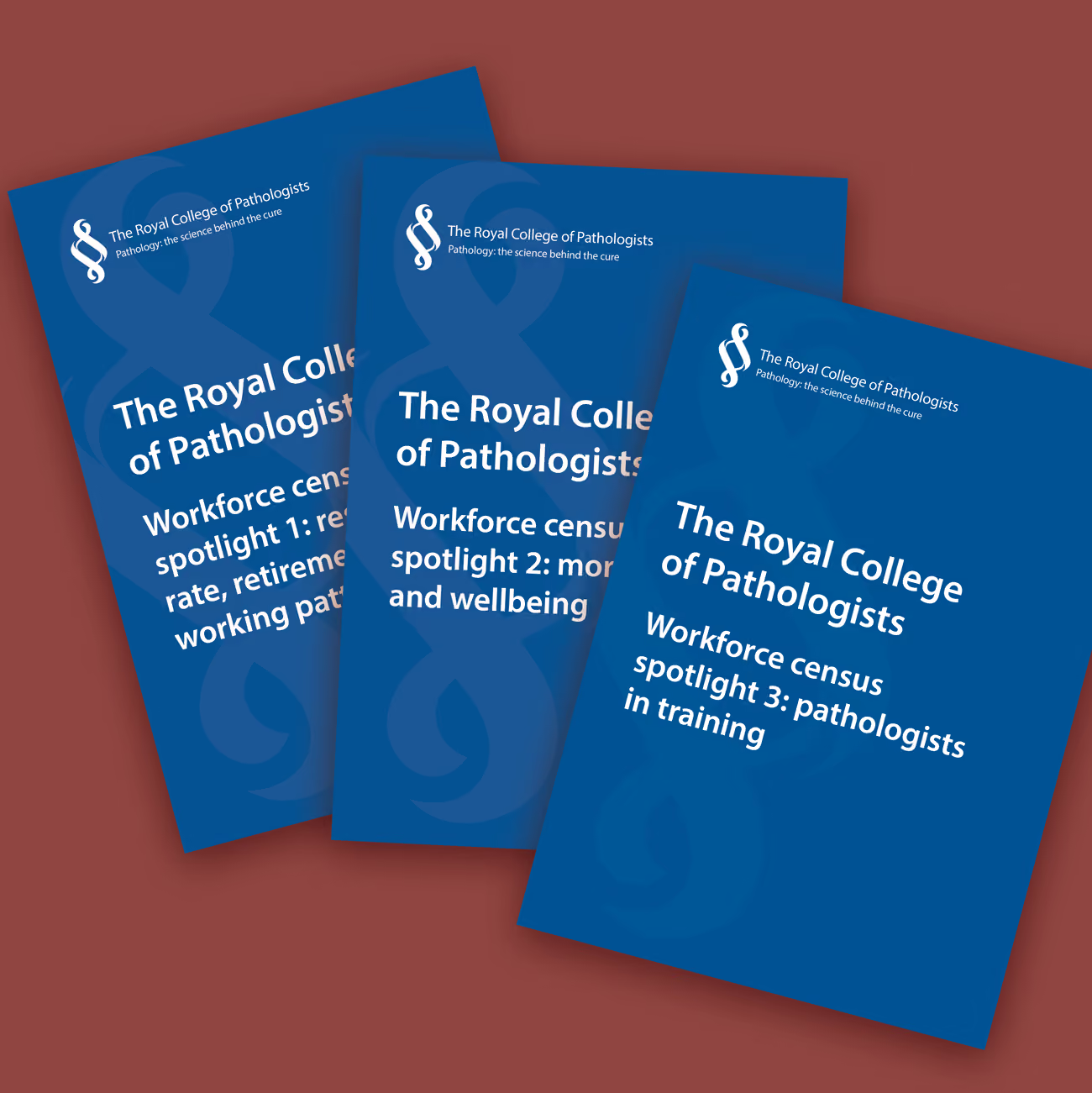
We developed a series of Workforce Census Spotlights exploring key themes including working patterns, retirement intentions, wellbeing and the experiences of pathologists in training. The first of these became The Pathologist’s most-read article of 2025.
We published two specialty workforce reports covering immunology and paediatric and perinatal pathology. Led by the Workforce team and developed in close partnership with Specialty Advisory Committees (SACs), clinical leads and colleagues from across the College, the reports also draw in 2025 Workforce Census data, direct-to-service surveys and Freedom of Information requests. There were also perspectives from external partners including charities. The reports illustrate the impact of high vacancy rates, fragile services, impending retirements and insufficient training capacity – and set out practical solutions to increase workforce capacity and improve service resilience. Our immunology report was acknowledged in the UK National Allergy Strategy in April 2026.

Our International Pathology Day (IPD) 2025 theme was the global pathology workforce. The day opened with perspectives from Jim Campbell, Director of the Health Workforce Department at the World Health Organization. Members, partners and pathology organisations from across the globe shared experiences, evidence and examples of good-practice solutions. This highlighted that, while workforce challenges vary between countries and healthcare systems, many pressures are shared – including workforce shortages, growing demand, increasing service complexity, retention concerns and the need to develop the next generation of pathologists.

Supporting the next generation of pathologists through their career entry and progression is a key part of the College’s work to maintain and our Pathology Summer School attracts more doctors into pathology to boost the workforce, introducing medical students to the specialty early in their careers. Our 2025 event welcomed 66 medical students from across the UK and offered lectures, workshops, case-based learning and networking opportunities. Feedback was highly positive, with many participants reporting increased interest in pursuing it as a career.

Our training and career development work
Strengthening the workforce and supporting bereaved families




We have consistently highlighted the urgent need for sustainable workforce development to safeguard patient safety, and we know that delays to post-mortem examinations can cause significant distress for families.
We were encouraged to see our paediatric and perinatal pathology workforce report recognised at parliamentary and policy levels, and broad media coverage, including in The Guardian, The Daily Mail, The Sunday Times and The Telegraph. Dr Clair Evans, Chair of the Paediatric and Perinatal Pathology Specialty Advisory Committee (SAC), discussed the challenges facing the specialty on BBC Radio 4’s Woman’s Hour. This reach has raised awareness of our members’ experiences and the consequences of workforce shortages for bereaved families.
We complemented this work with revisions to our perinatal post-mortem and placental examination guidelines, providing evidence-based approaches to managing workforce shortages while maintaining high standards of care.
In November 2025, we used our workforce evidence to engage directly with parliamentarians on areas most affected by shortages in paediatric post-mortem services. College President Dr Bernie Croal and Dr Clair Evans met Sarah Hall MP – who raised issues in parliament regarding the shortage of specialists available to undertake post-mortem examinations – to discuss concerns about access to paediatric pathology services, the distress post-mortem delays can cause for families and to provide a case for action. We are working with NHS England on the development of a formalised clinical network, to manage workloads in regions where the service has collapsed or is at risk, and recruitment incentives to address the shortages.
Modernising member support
This year, we redesigned our services in line with member needs, introducing new initiatives and enhancing existing benefits to make them simpler, faster and more accessible, while creating more opportunities for members to engage with and shape our work.
Our expanding programme of online events reached a wider UK and international audience. A digital approach with short, specialty-focused webinars has helped members stay connected to relevant professional developments wherever they are. Webinar recordings are made available where appropriate through the College website and Pathology Portal, creating a growing on-demand library of educational resources.
We remain committed to expanding the webinar programme in partnership with pathology specialties, enhancing the membership experience.
Feedback from a recent LEPT satisfaction survey highlighted strengths, and opportunities to modernise support for members throughout training and further improve the user experience.
This feedback is informing the current curriculum review, including workplace-based assessments and the LEPT system, which offered drop-in sessions. We have established a Curriculum Review Working Group to review the cellular pathology curriculum and its Capabilities in Practice (CiPs). There are dedicated subgroups to develop proposals in four priority areas to be presented to the Cellular Pathology College Specialty Training Committee (CSTC) later this year.
For medical microbiology and virology, work on the revised curricula is progressing as planned, with submission to the GMC scheduled to support implementation from August 2027.
Despite a challenging year, the Examinations team have continued to develop the examinations in a number of areas. A range of changes to specialty examinations have been submitted to the GMC for approval and others are under review pending submission. Following the FRCPath Part 1 examinations incident in autumn 2025, Part 1 examinations are reverting to online delivery in test centres hosted by the British Council, both in the UK and internationally, from autumn 2026. The team has worked proactively to ensure international examinations can be delivered safely and securely for both candidates and examiners wherever possible, adapting to the challenges posed by international conflicts.
We remain committed to supporting international medical graduate pathology training in the UK. In March 2026, NHS England closed the Medical Training Initiative scheme, and we have actively contributed to discussions about its future, highlighting the significant impact on Sri Lankan doctors, for whom overseas training is a mandatory part of postgraduate training. The International team successfully supported all 14 graduates who had submitted applications before the scheme closed, enabling them to proceed with UK training placements. The team is also updating the College’s sponsorship scheme information pack, which supports eligible doctors with GMC registration. We continue to work closely with international partners to provide guidance and support in light of the recent Medical Training Prioritisation Act.
The Pathology Portal: a collaborative approach to education
With more than 100 editors and contributors from across the profession developing and curating content, the Pathology Portal has continued to grow over the past year, attracting 2,000 new users, including international members, bringing total membership to more than 8,000. Over that time, it has seen 200,000 launches and, with more than 7,500 accessible, high-quality educational resources, it supports learning regardless of location, helping to reduce variation in educational experience across pathology.
The Portal has built on previous success in hosting external quality assessments (EQAs), with regular circulations supported through hosted slides and post-EQA reports.
The range of teaching delivered through the Portal has expanded significantly, combining innovative technology with expert-led content to widen access to progression. The haematology editorial team hosted a successful ST3 webinar series attended by more than 200 trainees. New inherited metabolic disease sessions were hosted for chemical pathologists, while the Portal’s extensive EQA slide collection continued to grow, supporting education and professional development in areas such as cardiac pathology, urology and skin pathology.
Tim Kendall
UK Liver Pathology Group
Strengthening the development of cancer datasets
Cancer datasets play a vital role in standardising cancer reporting, defining good practice in specimen handling and supporting high-quality cancer diagnosis and care.
This year, we supported the introduction of the Hierarchy of Evidence for Tumour Pathology into the cancer dataset development process. Designed specifically for tumour pathology, this framework provides a more appropriate method for evaluating evidence than traditional grading systems, which often focus on clinical trials and treatment interventions rather than diagnostic pathology.
The framework has improved support for dataset authors, helping them apply a consistent methodology, and will strengthen confidence in our recommendations and ensure evidence is interpreted in a way that reflects the realities of histopathology practice.